
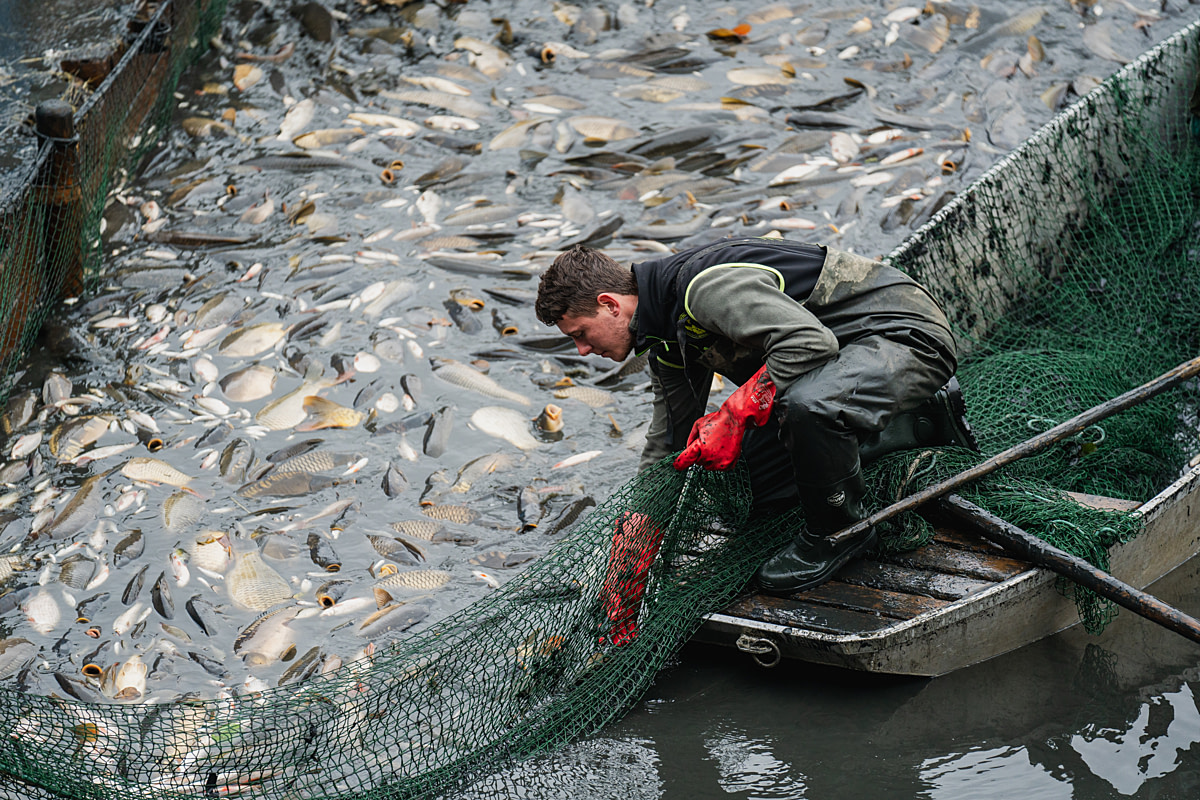

Fish squeezed inside a catching net gasp for breath as a fisherman in a boat adjusts the net during a traditional pond harvest. Undisclosed location, Central Bohemian Region, Czechia, 2024.
Lukas Vincour / We Animals
Every autumn in Czechia, a seasonal ritual unfolds across the countryside. Large fish ponds are drained, nets are pulled tight, and thousands of fish are lifted from the water. These annual traditional pond harvests are part work, part public event.
Inside Czechia’s Autumn Pond Harvests and Christmas Carp Tradition
At one 22-hectare pond in the Central Bohemian Region, our photojournalist Lukas Vincour documented spectators lining the banks: live music, families with children, and vendor stalls. In one morning, an estimated 6,000 to 8,000 fish were removed from the water. Most of these were common carp, joined by catfish, grass carp, zander, pike and bighead carp.

Fish are sorted in a trough by fishermen during a traditional pond harvest while other fish struggle in a crowded net nearby. Undisclosed location, Central Bohemian Region, Czechia, 2024.
Lukas Vincour / We Animals

A brass band plays near an on-site market at a traditional pond harvest. Undisclosed location, Central Bohemian Region, Czechia, 2024.
Lukas Vincour / We Animals

Animal photojournalist Lukas Vincour documents a traditional fish pond harvest. Undisclosed location, Central Bohemian Region, Czechia, 2024.
Lukas Vincour / We Animals
The Mechanics of a Harvest
During the harvest, once the water level is low enough, fishermen drive fish toward shore by striking the surface with long poles. Nets are drawn in, and fish are lifted by crane. They are then dumped into troughs, sorted by species, weighed and either loaded into transport trucks or killed on-site for customers.
Roughly 40 percent of the fish taken at this event were killed and butchered at the market stalls on-site. For the rest, the ordeal was not yet over. They were moved to holding ponds for later sales, many destined for temporary Christmas markets across Czechia.
Fish squeezed inside a catching net writhe and gasp for breath as a fisherman sits in a boat nearby during a traditional pond harvest. Undisclosed location, Central Bohemian Region, Czechia, 2024.
Lukas Vincour / We Animals


Christmas Carp: A Seasonal Tradition
In cities throughout the country, short-term fish stalls appear about a week before Christmas Eve. Here, thousands of live carp are held in crowded portable tanks. Customers choose their fish and can have them killed and butchered on-site for an added fee, or take them home alive in plastic bags to be killed later.
At home, carp are commonly kept in bathtubs in chlorinated water (which is toxic to fish) for several days before slaughter. Handling at these markets can be rough. Fish are often seen struggling on counters, falling to the ground or inadequately stunned before slaughter. Our photojournalist documented one fish still moving while being descaled.

Christmas season fish vendors wait outside a city shopping mall to sell fish traditionally purchased for a Christmas Eve meal. Customers may purchase the fish live or have them killed on the spot. Undisclosed location, Central Bohemian Region, Czechia, 2024.
Lukas Vincour / We Animals

A live carp is carried to a sales table by a fish vendor at a Christmas season fish market. This fish will either be killed on the spot or sold live to a customer to kill at home for their Christmas meal. Undisclosed location, Central Bohemian Region, Czechia, 2024.
Lukas Vincour / We Animals

A live grass carp is held down on a table by a fisherman moments before he stuns and kills them for a customer at a traditional pond harvest. Undisclosed location, Central Bohemian Region, Czechia, 2024.
Lukas Vincour / We Animals
A growing body of scientific research confirms that fish are capable of feeling pain and stress. In this context, the handling and conditions observed during harvests, markets and hatchery processes raise clear welfare concerns.
According to the State Veterinary Administration, nearly 3,000 of these Christmas fish markets operated across Czechia in 2023. Early reports suggest fewer stalls in 2024, but research indicates more than five million carp are still killed annually, most of them destined to be eaten for Christmas Eve dinner.
A recent investigation by Compassion in World Farming revealed shocking levels of suffering on carp farms in Czechia, demonstrating the urgency for stronger fish welfare laws in the EU.
Inside the Hatcheries
Fish farming has deep roots in Czechia, especially for carp. For this project, Lukas Vincour documented several facilities, from small trout farms to one of the country’s most modern hatcheries.
At a trout hatchery, rainbow, brown and brook trout, along with burbot, are bred for fishing grounds and direct sales. Eggs and milt are manually stripped from broodstock during spawning season, fertilized, and kept in cold-water incubation devices until hatching. Once fry absorb their yolk sacs, they’re moved to flowing-water tanks, where several dead and dying fish were observed.
At a larger hatchery in Pohorelice, workers extracted eggs from female carp, mixing them with milt and a diluted cow’s milk solution to remove stickiness before transferring them to incubation cylinders. Incubation typically lasts three to five days. Some broodstock showed bruising or lethargy before being placed back into transport tanks.

A female common carp held down on a table at a freshwater fish hatchery gasps for oxygen as workers prepare to cover her head with a towel and extract her eggs for artificial fertilization. Rybnikarstvi Pohorelice, Pohorelice, South Moravian Region, Czechia, 2025.
Lukas Vincour / We Animals


A Seasonal Cycle
“Photographing fish is always a peculiar experience for me. So much happens to them, and yet they remain silent. The fish often fell to the ground, but no one seemed to care; most of the time, people laughed as they tried to catch them on the ground. It was mostly quiet, except for the fishermen encouraging each other. There was also a fair amount of alcohol, which the fishermen were drinking during the harvest. The public came to watch, including kindergartens with children. The comments from the teachers made me sad. They laughed when the fish fell to the ground, and when the fish were dumped into the transport cars, they remarked how the fish had a nice slide.” — Lukas Vincour, Animal Photojournalist
Fishermen use poles to beat the water surface of a fish pond to drive fish toward a capture area during a traditional harvest. Undisclosed location, Prague-East District, Central Bohemian Region, Czechia, 2024.
Lukas Vincour / We Animals
Together, the scenes from these images reveal the whole system of the season, from public pond harvests to Christmas markets and the hatcheries that supply them. Czechia’s holiday traditions depend on a supply chain that stretches from muddy autumn ponds to bathtub-held carp on Christmas Eve.
Explore and download these visuals and more via the We Animals Stock Site.