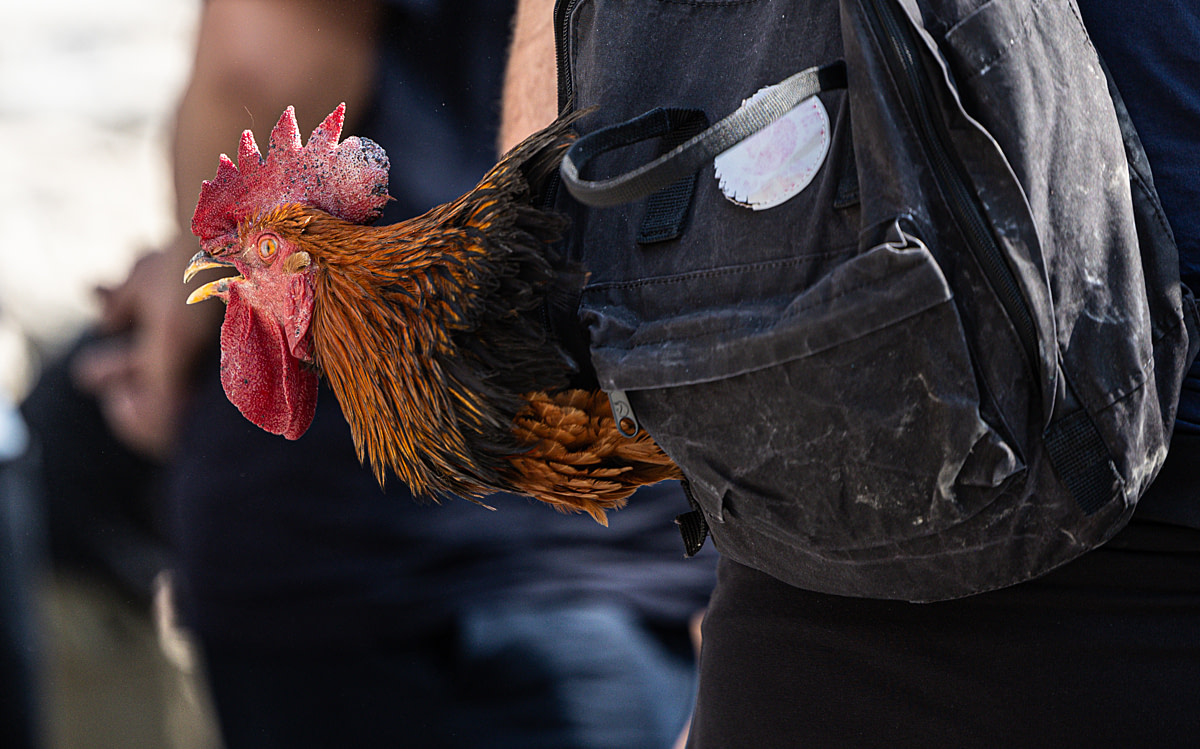
Andrew Skowron / We Animals
[Content warning: Contains confronting images and/or video footage]
Each year in the mountains of Georgia, thousands of pilgrims climb toward a small hilltop church, walking and carrying sheep, lambs, calves, cattle and roosters. Many are praying for health, protection or prosperity. By the end of the day, hundreds of animals will be dead.
In 2025, We Animals photojournalist Andrew Skowron documented Lomisoba. These visuals capture what he witnessed during the festival.
Lomisoba takes place annually in the village of Mleta on the seventh Wednesday after Easter. The festival began centuries ago as a pre-Christian mountain ritual before becoming absorbed into Georgian Orthodox tradition and linked to Saint George, the country’s patron saint. The road into the village slowly turns into a marketplace. Farmers sell animals from roadside stalls while pilgrims negotiate prices beside tied sheep and roosters packed into sacks or carried by their wings in the heat. Families then lead the animals uphill toward the church, often for hours without shade or water. Some sheep collapse from exhaustion before reaching the top.

A collapsed lamb lies at the bottom of the steps near the village church while a pilgrim tries to force them to stand by pulling on the rope around their neck during the Lomisoba Festival. Animals already exhausted from being forced to walk the festival pilgrimage in hot weather without water are made to continue the final uphill section to the church for blessing before being sacrificed. Mleta, Dusheti, Georgia, 2025.
Andrew Skowron / We Animals

A sheep tries to resist as pilgrims with a small child drag them by the horns to the village church during the Lomisoba Festival. Animals already exhausted from being forced to walk the long pilgrimage in hot weather without water are made to continue the final uphill section to the church for blessing before being ritually sacrificed and butchered. Mleta, Dusheti, Georgia, 2025.
Andrew Skowron / We Animals

Pilgrims lead and push sheep around the village church during the Lomisoba Festival. The animals are often already exhausted from being forced to take part in a long pilgrimage journey in hot weather before being blessed at the church and then ritually sacrificed. Mleta, Dusheti, Georgia, 2025.
Andrew Skowron / We Animals
At the church, pilgrims circle the building twice while clergy bless the animals. The moment shifts between devotion and disorder. Animals resist by bracing their legs, lying down or trying to escape through the crowds. Many are shoved, dragged, or kicked forward, sometimes by children helping their families manage the animals. After the blessing, the animals are brought to a concrete square for slaughter. Killings occur in full view. Local butchers cut throats or sever heads with knives without prior stunning while blood runs across the ground and families wait nearby to prepare communal meals. Skins, heads and organs accumulate in piles as the day continues.

A sheep offered for sale for blessing and slaughter at the Lomisoba Festival, lies quietly bleating while tied under the sun without food or water behind the village church. The exhausted animal is tangled in their rope tether and cannot move freely. Mleta, Dusheti, Georgia, 2025.
Andrew Skowron / We Animals

A sheep offered for sale to pilgrims as a sacrifice makes eye contact while straining against a tether behind the village church during the Lomisoba Festival. The animals are tied with long ropes that restrict their movement and cause them to become tangled, standing in sun without shade until they are purchased, blessed and slaughtered. Mleta, Dusheti, Georgia, 2025.
Andrew Skowron / We Animals

A pilgrim carries a rooster upside down by their legs and two sheep are led on ropes on the pilgrimage to the village church during the Lomisoba Festival. These animals will blessed at the church before being ritually sacrificed in a nearby slaughter area. Mleta, Dusheti, Georgia, 2025.
Andrew Skowron / We Animals
For many pilgrims, the sacrifice is an act of faith tied to family tradition and spiritual protection. But standing in the middle of the square, it becomes difficult for photojournalist Andrew Skowron not to notice the collision between ritual and suffering.
Traditions survive because they are passed down—but they can also evolve.
On March 17, 2026, Patriarch Ilia II, known for maintaining religious sacrifice in the Georgian Orthodox Church, passed away at the age of 93. Will his successor, the Metropolitan Shio (Mujiri), choose to lead an institution with more modern views on animal sacrifice and implement positive changes at future Lomisoba festivals?