
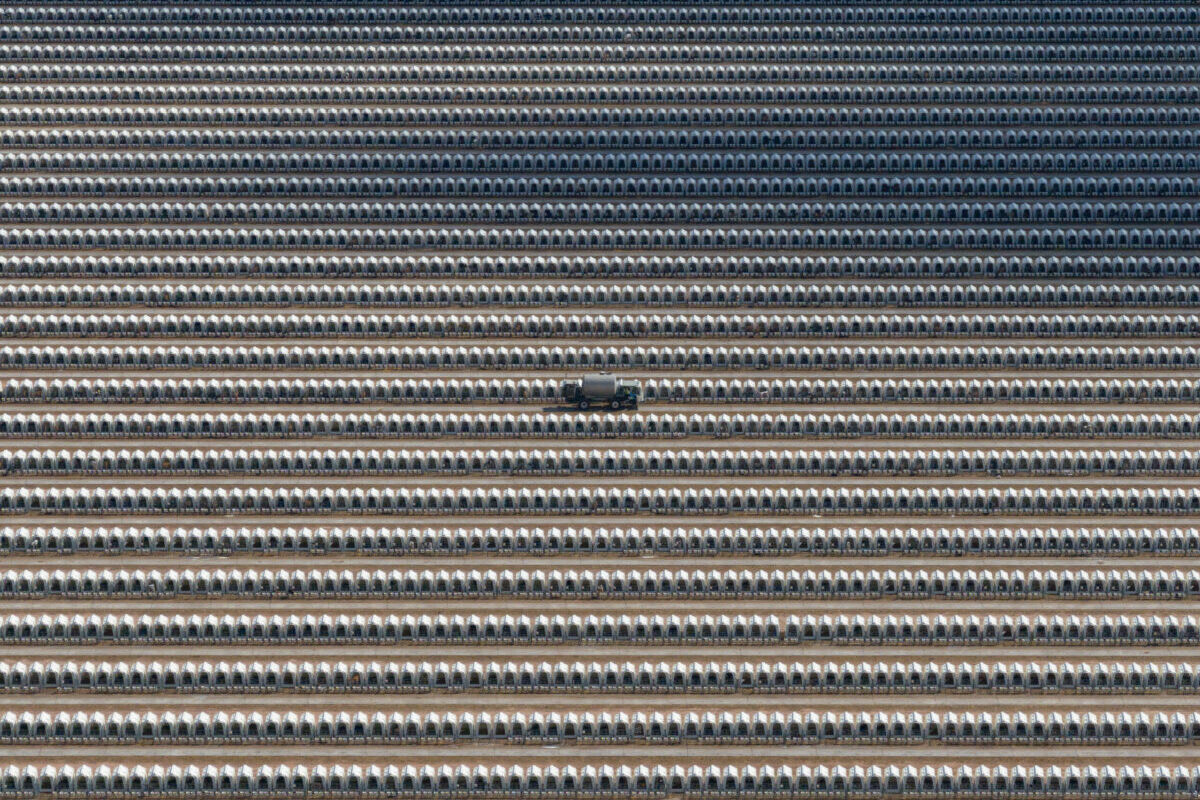
A milk dispenser truck drives between some of the thousands of calf hutches in a massive dairy farm’s yard. Turkey Creek Dairy, Pearce, Arizona, USA, 2023.
Ram Daya / We Animals
The U.S. Federal Aviation Administration (FAA) is considering a proposal that could make it more difficult to use drones to document some industrial animal agriculture facilities.
The proposal would allow certain “fixed site facilities”—defined as permanent locations with buildings, infrastructure, equipment, or operations that remain in one place and could be considered important to public safety, security, or the economy—to apply for official drone flight restrictions. While the rule is intended for facilities that meet specific security and safety criteria, such as chemical plants, oil refineries, and water treatment facilities, the FAA is now asking whether some food and agriculture facilities should be eligible to apply for drone restrictions, too. If approved, drone pilot apps would display these locations as restricted airspace, limiting where photographers and journalists can legally fly.
An aerial view of the long rows of more than 1,000 wooden hutches housing dairy calves at a calf farm. The hutches are fully exposed to the summer heat. San Bernardino County, California, USA, 2023.
Ram Daya / Animal Outlook / We Animals
Why Drone Photography Matters
For photographers, drones provide a safe, affordable, and legal way to visually document places that can be difficult to observe from the ground. While photographs taken from the ground remain essential, drones provide perspectives that are often impossible to capture otherwise. Large animal agriculture facilities can span hundreds or even thousands of acres, making it difficult to understand their scale and environmental footprint from public roads or ground-level vantage points.
So much of what happens to farmed animals is deliberately hidden from public view. Drone imagery provides a unique window into their world, exposing issues of public interest. At We Animals, drone photography has helped us document the scale of industrial animal agriculture, verify animal welfare claims, and capture the impacts of disasters, mass mortality events, and environmental harm. It is not about intrusion; it’s about transparency and accountability. – Victoria de Martigny, We Animals Director of Visual Content
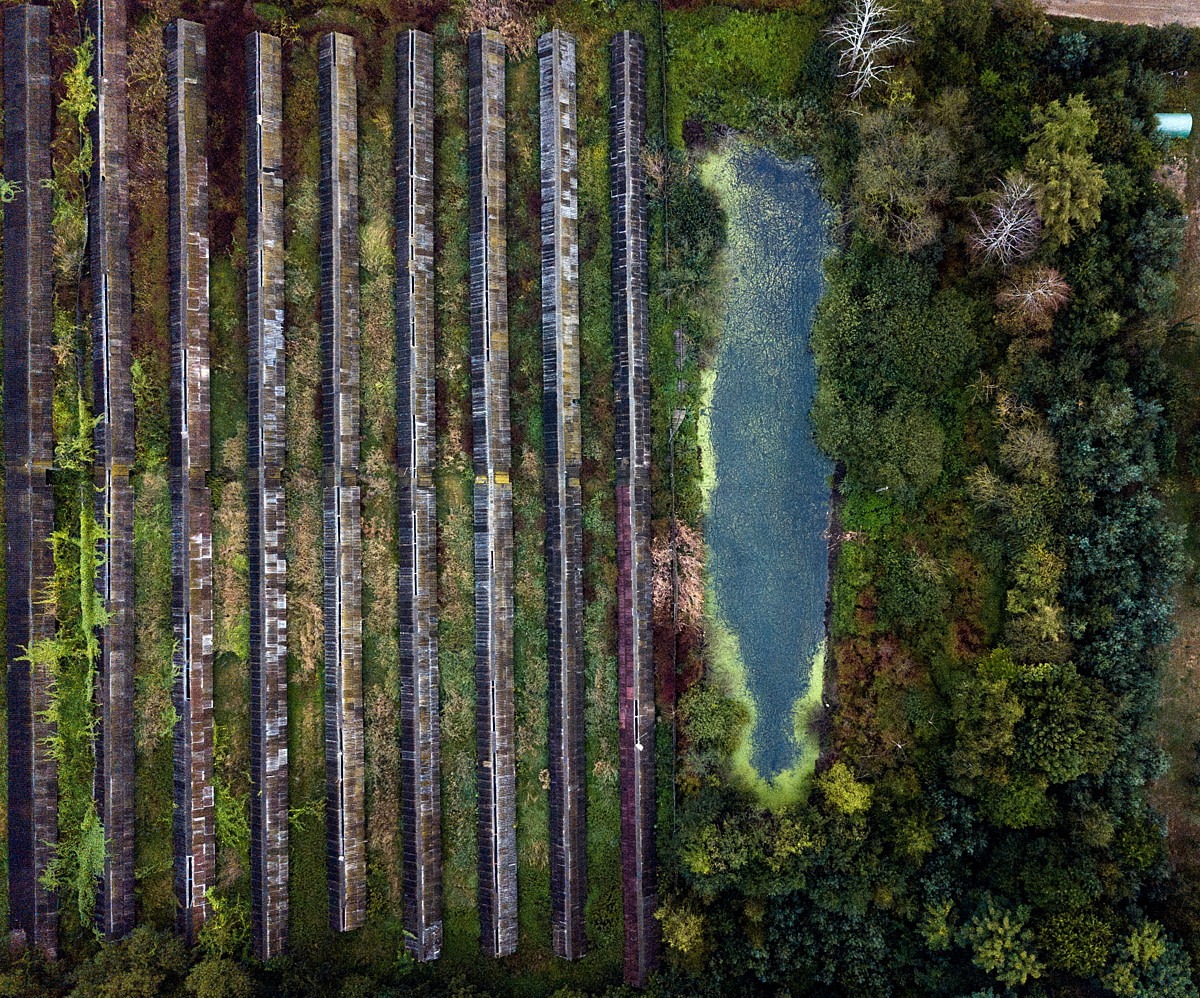
An aerial view of a shuttered mink farm, closed for several years and located deep in a forest near a town. The facility once housed tens of thousands of mink who were raised for their fur. Vegetation grows over what remains of the partially dismantled structures. Poland, 2019.
Andrew Skowron / We Animals
Why we’re concerned
While the FAA proposal does not automatically restrict drone access to all agricultural facilities, it could create a pathway for some facilities to seek restrictions on aerial documentation. We Animals believes that responsible drone photography serves the public interest. Aerial imagery helps the public understand issues related to animal welfare, the environment, food production, and disaster response. It is a critical tool for visual storytelling and education.
Professional drone operators in the U.S. already operate within a framework of federal, state, and local regulations designed to promote safety. We Animals supports responsible drone operation and works with qualified drone operators who comply with applicable FAA requirements. Our concern is not that drone operators must meet safety and licensing standards. Rather, it is that site-specific flight restrictions could prevent journalists and photographers from documenting matters of public interest.
An aerial view that vertically pans along the burnt remains of a chicken shed where 120,000 hens perished by fire. Oakdell Egg Farms, Lewiston, Utah, USA, 2024.
Wes Burdett / We Animals
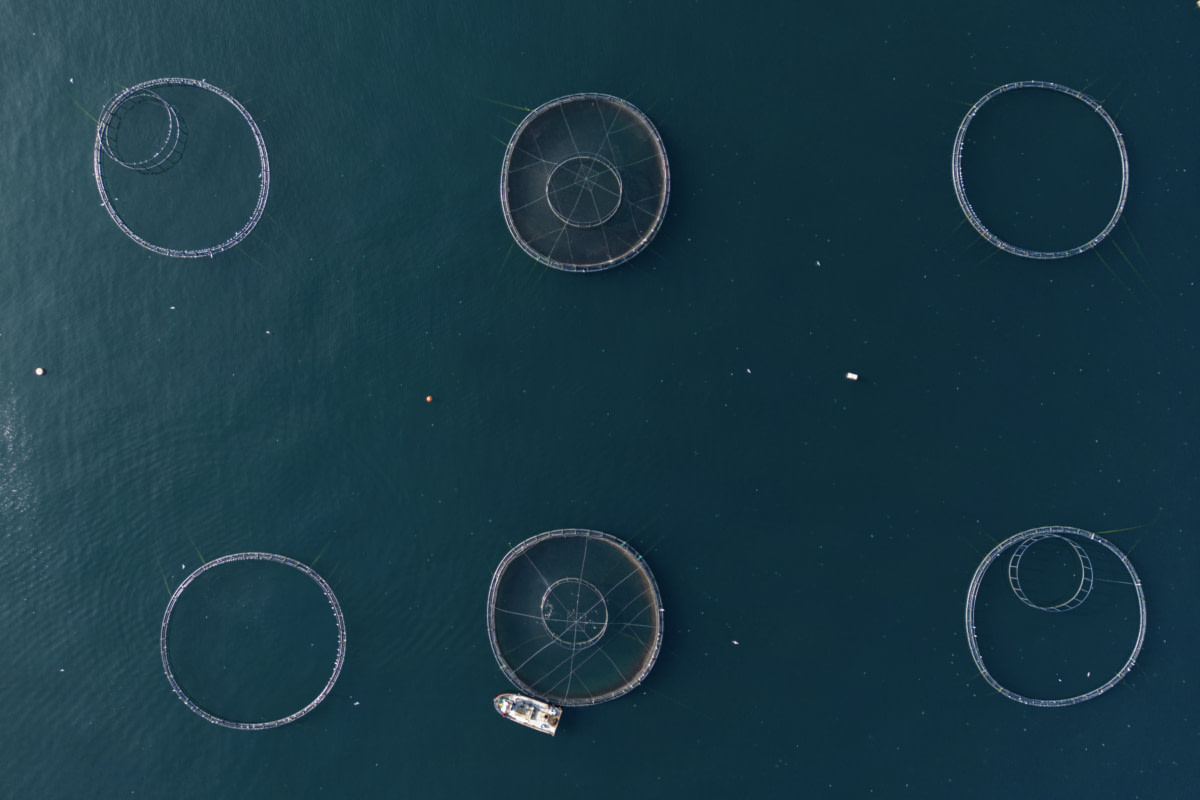
Six fish farm cages float on the ocean, covered with netting to prevent birds from eating the fish inside. Trabzon, Trabzon Province, Black Sea Region, Turkiye, 2023.
Havva Zorlu / We Animals
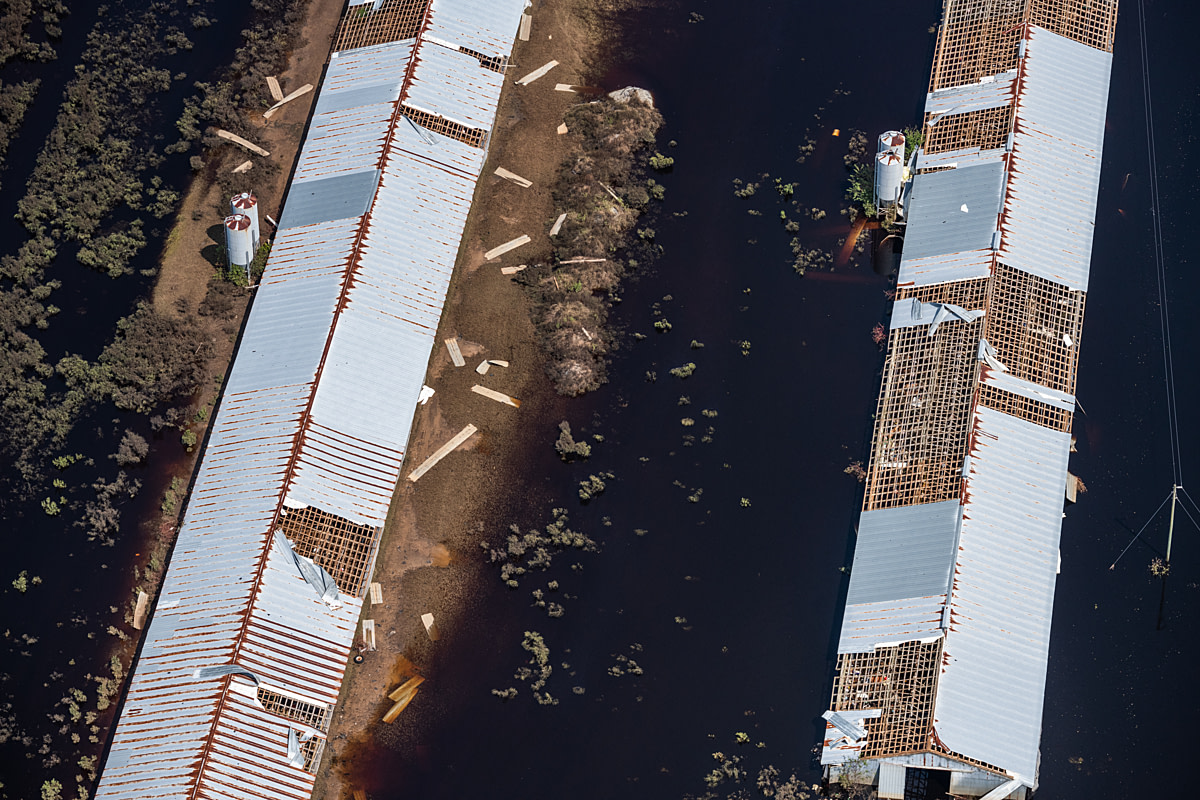
Aerial view of a CAFO farm surrounded by flood waters in Duplin County. Duplin County, North Carolina, USA, 2018.
Jo-Anne McArthur / We Animals
An Opportunity for Our Voices to be Heard
The FAA is currently accepting public comments on the proposal. The deadline for comments is now August 5, 2026.
If you are a photographer, journalist, advocate, researcher, or anyone who values transparency and public access to information, we encourage you to review the proposal and consider submitting a comment.
Public feedback helps agencies understand how proposed rules may affect different communities and professions, including those who use photography to document issues of public concern.
We Animals recently collaborated with FarmSTAND, a legal advocacy organization focused on industrial animal agriculture, on a public comment submitted in response to the proposal.
Drone photography has become one of the most important tools for making the often-hidden world of industrial animal agriculture visible. We hope the FAA will carefully consider the public value of aerial photojournalism as it evaluates this proposal.
Drone photography does more than help tell stories—it helps make otherwise hidden systems visible. – Victoria de Martigny
Thousands of dead chickens are removed from a shed by conveyor belt and loaded into a truck at a factory farm. Iowa, USA, 2022.
Direct Action Everywhere / Open Wing Alliance / We Animals
Pigs are ushered into makeshift gas chambers during a mass culling operation following outbreaks of African Swine Fever in the region. Sairano, Pavia, Italy, 2023.
Selene Magnolia Gatti / We Animals
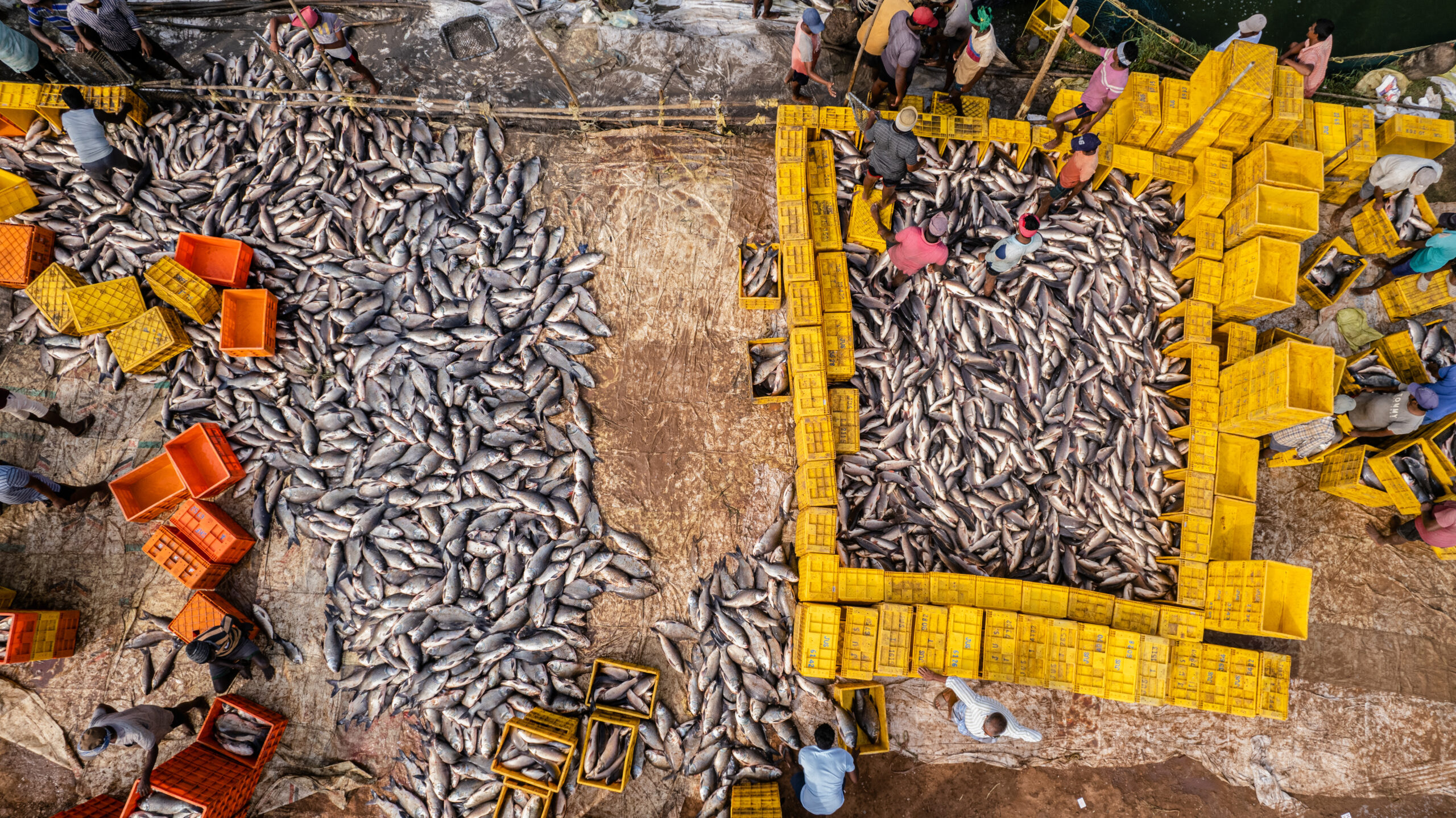
Thousands of fish lie dead or dying on the ground amid workers packing them for transport during a harvest on a fish farm. While transport trucks wait nearby, workers scoop up fish trapped inside a harvesting net with mesh baskets and dump them in a sorting area. The fish are not stunned or slaughtered during harvests but simply removed from the water to eventually die while they are sorted and packed for transport. This farm raises catla (katla) and rohu. Andhra Pradesh, India, 2023.
Shatabdi Chakrabarti / FIAPO / We Animals